Range Host
Backends
The provider realizes ranges through the backend INSPECT_RANGES_HOST selects: two built-ins, or a custom backend the variable’s own value registers (Implementing a Host Provider):
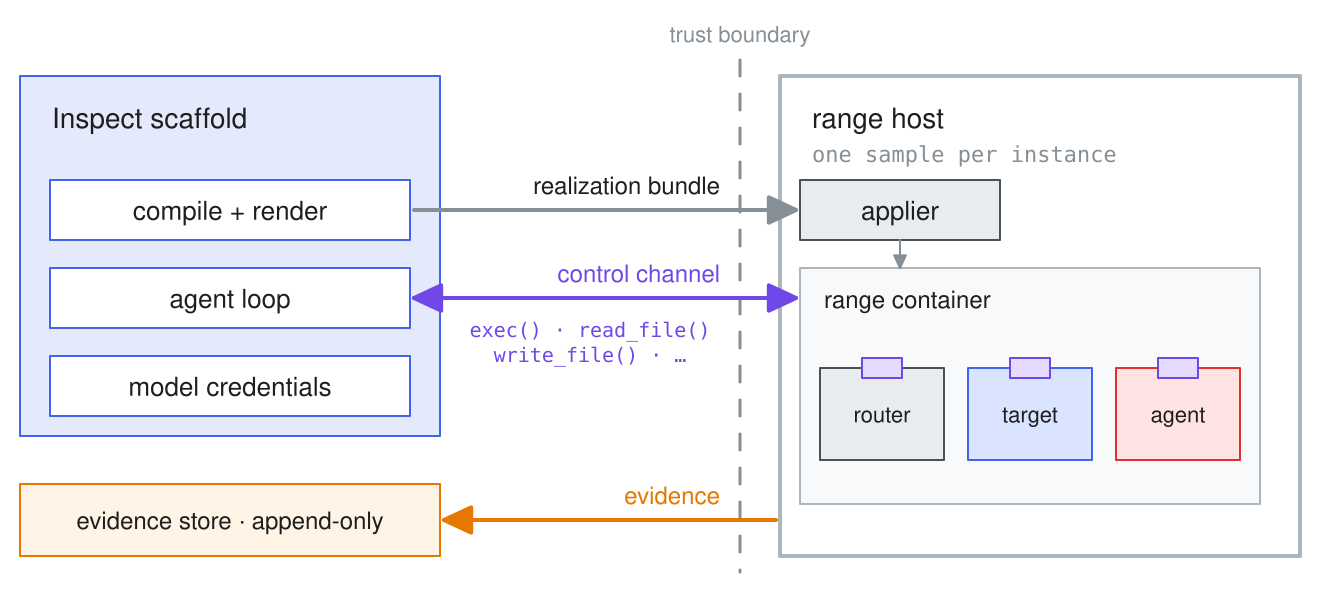
local(the default): the co-resident path. The driver (the Inspect eval process that owns the sample) renders the realization bundle (the digest-manifested directoryrenderemits; see Operations) and runs realization in-process; guests are reached directly over vsock. The only addition over a plain setup is the host lease every sample holds (below).uds:<socket>: the separated topology on one host. A standinginspect-ranges applierprocess owns realization and teardown; the driver talks to it over a unix socket, and every guest operation relays through the same socket as an opaque byte stream. The driver still renders bundles (the compiler toolchain is driver-side) and still leases vsock CIDs (context ids); the applier verifies the bundle digest and runsup.<module>.<factory>[:<config>]: a registered backend. The dotted path names a factory from theinspect_ranges.hostextension point, imported and called at resolution; the text after the first colon is the backend’s own config (Registering a Backend).
# terminal 1: the applier (one per host; refuses unhealthy hosts)
inspect-ranges applier --socket /run/user/1000/ir-applier.sock

# terminal 2: evals through it
INSPECT_RANGES_HOST=uds:/run/user/1000/ir-applier.sock \
  inspect eval my_task.py
Both backends behave identically at the eval surface: same sandboxes, same ops, same cleanup semantics. The separated topology isolates the process that parses attacker-influenced bytes from the process holding credentials (Security covers when to prefer it). On one host it buys crash independence (a dead driver no longer strands cleanup knowledge in a dead process) and is the step toward multi-host dispatch.
Keep socket paths short: AF_UNIX paths cap at about 107 bytes, so prefer /run/user/<uid>/... or a short /tmp directory over deeply nested trees.
Lease Contract
Every sample holds a host lease: an identity plus an absolute expiry, recorded in leases.json beside the CID registry under the shared state dir. The driver renews it at a third of the TTL (INSPECT_RANGES_LEASE_TTL_S, default 600 seconds); renewal is an on-disk compare-and-swap, so there is zero hot-path wire chatter. Release is destruction: a lease is removed only after a successful teardown, and a used host is never returned to a pool.
The expiry-mid-sample policy: the reaper reclaims on expiry alone and never probes liveness. A healthy sample never expires, because renewal is independent of sample activity; the only way to expire mid-sample is a dead or wedged driver, which is exactly what the reaper exists for. If a running sample’s lease is reclaimed anyway (forced expiry, operator intervention), the driver fails the sample loudly with LeaseLostError at its next operation rather than letting it limp along on a reclaimed host. There is no looks-alive grace period; adding one would reintroduce the dependence on driver liveness that leases exist to remove.
Operating the Reaper
inspect-ranges reaper is the independent cleanup process: fresh-process, on-disk only, never dependent on the original driver reaching its finally.
inspect-ranges reaper                # one sweep; exit 1 on failure
inspect-ranges reaper --interval 60  # daemon: sweep every minute
A sweep selects expired (and crashed-mid-reap) leases under the registry lock, re-checking expiry so a renewal that just landed spares its lease, and marks them reaping, which fails any further renewal. Teardown runs outside the lock. Only after a successful teardown does the sweep release the CID lease, clear staging and ownership records, and remove the host lease last. A failed teardown frees nothing: the lease stays findable and the next sweep retries.
Teardown dispatches on each lease’s recorded origin (the INSPECT_RANGES_HOST value that minted it). uds: leases tear down through the applier socket (which also releases the resources the applier charged against the host at admission; see Operating the Applier), falling back to direct teardown with a logged warning when the applier is unreachable; a registered backend’s leases tear down through its own reclaim connector. An origin this machine cannot resolve (the backend’s package is not installed here) deliberately reclaims nothing: a direct teardown against a host that lives elsewhere would “succeed” vacuously and release the lease over a still-running range, so the sweep reports origin-unresolvable and retries until the package is installed where the reaper runs.
inspect-ranges doctor reports lease health in its Host group, including an expired-leases hint that names the reaper.
Operating the Applier
inspect-ranges applier --socket <path> [--state-dir <dir>] [--image-cache <dir>] serves two planes on one 0600 socket (same-uid trust): the host plane (realize, teardown, heartbeat) and a per-guest byte relay. It runs the doctor readiness subset at startup and refuses to serve an unhealthy host.
Realize is gated: the requested bundle digest must match the lease’s rendered bundle (EINVAL otherwise), fetch grants must be empty (below), and the range’s declared resources are charged against the applier’s own admission gate, which refuses rather than queues: EAGAIN when the host is full right now (the driver respins), ENOSPC when the range alone exceeds the host (permanent). One realize per lease: a second realize on a live lease refuses EBUSY until teardown.
Applier restart loses in-process state: the replay log, guest relay map, and admission charges live in process memory and die with it (logged loudly at startup when live leases exist). Running samples keep their VMs; their teardowns recover from disk (the driver’s teardown, the reaper, or inspect sandbox cleanup range), and new samples are served cleanly. When the applier is fully dead and a lease still exists, inspect sandbox cleanup range fails loudly by design (teardown for a leased project routes through the applier); recovery is reaper-only, via its direct-teardown fallback and the logged charge-leak warning.
Grants Convention
realize carries a list of fetch grants for image delivery. Today the only supported delivery is pre-seeded: the image cache on the host already holds the verified golden chain, and the grants list must be empty. Pre-seeding is any of the Images recipes run on the host (images pull, a mirror, or a pin file) plus inspect-ranges pull for published range builds. A non-empty grants list refuses with ENOTSUP rather than silently ignoring it, so a deployment that expects granted-URL delivery fails at realize, not mid-boot. Granted-URL and registry delivery are the image-distribution growth path.
Isolation Claim
Every lease records an isolation claim, and the provider logs it once per sample acquisition. Both built-in backends claim isolation="shared": one host’s kernel, device emulation, and caches are reused across samples, so a guest-to-host escape in one sample could reach another sample’s resources. The claim labels the eval log honestly; it enforces nothing. isolation="instance" (a fresh host per sample) may be claimed only by a registered backend that genuinely provides one.
Implementing a Host Provider
Custom backends are a public extension point: the protocols live in inspect_ranges.host, and registration is the environment variable itself. Both built-in backends implement one seam, two protocols:
- HostProvider acquires and releases range hosts.
acquire(sample, placement)takes the sample’s identity (SampleSpec: sample and task ids, the spec hash, the rendered bundle digest, declared resource totals) and the driver-side placement facts the lease record needs (LeasePlacement: project name, bundle path, staging, the evidence location), and returns a leased RangeHost.releasedestroys.abandonis the deliberate keep-it-running path (cleanup=False): renewal stops, the lease stays, and the reaper reclaims after expiry. - RangeHost is one acquired host: the RangeChannel to it (the transport-agnostic control plane every guest operation rides;
Nonebetween acquire and boot in the co-resident backend, which builds it from booted guest CIDs), theisolationclaim, the deployment’s declaredcapabilities, and its host-classfacts.check_lease()raises LeaseLostError when the lease has been reclaimed, which is how lease loss fails a sample loudly at its next operation.
An implementation is held to the contracts this page already describes, plus three from the design record:
- Lease semantics.
acquirereturns identity plus expiry; crashes, interrupted acquisition, partial boots, and network partitions are normal cases, not exceptions. Cleanup must be recoverable from recorded ownership by an independent process, never dependent on the original driver reaching itsfinally. - Release is destruction. A used host never returns to a pool, and under
isolation="instance"release means the instance is destroyed or handed to independently controlled reprovisioning. The claim must be honest: it is logged per sample, and"instance"may be claimed only when the deployment actually provides a fresh host per sample. - Capabilities refuse at planning. HostCapabilities declares what the deployment can do (image delivery, upstream forwarding, egress grants, evidence delivery); a range whose requirements exceed the declaration refuses before anything boots, never degrades silently. No planner comparison exists yet (v1 pins every capability to its only supported value), so honor the gate by refusing in
acquirewhen a range needs what your deployment cannot provide.
Registering a Backend
The variable’s value is the registration: any value that is neither local nor uds:<socket> is a dotted import path naming a factory, split at the first colon (so a config may itself contain colons). There is no registry call to make and no companion variable to keep in sync; the backend’s package just has to be installed where evals, doctor, and the reaper run.
INSPECT_RANGES_HOST=mypkg.hosts.fleet:region-a \
  inspect eval my_task.py
The factory receives the verbatim value, the config, and the shared state dir, and returns the backend bundle:
mypkg/hosts.py
from inspect_ranges.host import (
    HostBackend,
    HostBackendContext,
    MessageChannel,
)


def fleet(ctx: HostBackendContext) -> HostBackend:
    """Factory: cheap, dials nothing (acquire does the work)."""
    return HostBackend(
        provider=FleetProvider(ctx.origin, ctx.config, ctx.state_dir),
        channel_for_lease=lambda lease: MessageChannel(
            FleetTransport(ctx.config, lease.lease_id),
            label=lease.project,
        ),
    )
provider is the HostProvider. channel_for_lease marks the backend separated: supply it and the runtime derives its boot, teardown, and per-guest channel seams from it, exactly how the uds: backend is built; leave it None for a co-resident backend that keeps the local realization path. A realistic separated backend implements one Transport (per-endpoint connect) and wraps it in MessageChannel, inheriting the whole wire discipline: request ids with idempotent resend, retries, the layered budgets, and strict validation of every reply as untrusted input. The optional reclaim overrides the reaper’s teardown connector, and doctor_probe gives inspect-ranges doctor a reachability check.
Two requirements make crash recovery work:
- Stamp the origin. The provider must record
ctx.originverbatim as each lease’s origin (LeaseStore.acquire(origin=...)). The value is the self-describing teardown address: a fresh process re-resolves it by import alone. Extra placement data (instance id, region) rides inside the config portion of the value. - Install the package where the reaper runs. An origin the reaper cannot resolve reclaims nothing, per the reaper’s dispatch rule;
doctorwarns about lease origins its environment cannot resolve.
doctor resolves the variable the same way the provider will, so a typo’d or uninstalled backend fails the host checks instead of the eval (which otherwise refuses at startup, before anything renders or boots). The out-of-band oracle attach (range_oracle) remains local-only: it dials this machine’s recorded guest sockets and refuses under any other backend. Entry-point scheme aliases (pretty names resolved from installed package metadata) are a compatible future addition; the dotted-path grammar stays.
What is not built yet, concretely: granted-URL and registry image delivery (pre-seeded is the only shape, per the grants convention), forward_upstream and egress_grant capabilities (pinned False), and isolation="instance" in any built backend (a registered backend that genuinely provides a fresh host per sample may claim it). Evidence delivery has one built mode: the host writes to the per-sample location the driver hands it at acquire, through a put-only credential.
Environment Vars
| Variable | Default | Effect |
|---|---|---|
INSPECT_RANGES_HOST |
local |
Backend selection: local (co-resident), uds:<socket> (a running applier), or <module>.<factory>[:<config>] (a registered backend). |
INSPECT_RANGES_LEASE_TTL_S |
600 | Host lease TTL in seconds; the driver renews at TTL/3. A dead driver’s sample becomes reclaimable one TTL after its last renewal. |
INSPECT_RANGES_HOST_CLASS |
unspecified |
The host-class name recorded in lease host facts (declarations, never per-instance probes). |
INSPECT_RANGES_ATTACK_BOX |
unset | External attack-box provider registration (<module>.<factory>[:<config>]), consulted where realization runs: the driver under local, the applier’s own environment under a separated backend. |
The provider’s own knobs (concurrency, retries, image cache) are on the Range Sandbox page and apply unchanged under either backend.